2/19/2015

"Fincher puts together an excellent puzzle"

Title: Gone Girl
Year: 2014
Genre: Drama, Mystery, Thriller
Director: David Fincher
Writer: Gillian Flynn (written by); Gillian Flynn (based on his novel)
Runtime: 149min
Cast: Ben Affleck, Rosamund Pike, Kim Dickens, Tyler Perry, Carrie Coon, Neil Patrick Harris
Produc.: Twentieth Century Fox Film Corporation, Regency Enterprises, TSG Entertainment, Artemple - Hollywood, New Regency Pictures, Pacific Standard
Presup.: $61 million approx.

I think it wouldn´t be false, but just fair, to say that the quality of a good movie could be seen as directly proportional to its ability to captivate us. And I stress upon this for a very specific reason. Many of the greatest films have had probably got lots of errors that the enthusiastic viewer wouldn´t notice. For my part, after watching Gone Girl I could probably strive to recount the facts and perhaps come to the conclusion that there were some gross plot mistakes, but to be perfectly honest, I doubt anyone would want to spend five minutes of their lives trying to find them.
Anyone who´s seen Guy Ritchie´s Sherlock Holmes and liked it, probably would have overlooked if anything didn´t fit. The thing is that both, on the side of villains planning stuff, as in the deductive right guess of our detective, it´s so fast how it all happens, that to see the mistakes, if any, would be hard. What, however, isn´t for us so difficult to qualify as good, is the whole package.
The same could be said on the development of the facts in Now You See Me (2013), where events happen so fast that even once explained, one can´t do nothing but to force itself into believing them.
With Gone Girl it´s another case where many have decided to hate Fincher, unhappy with the unreliability of some things. I'm not a cop or possess detective skills, which maybe, these people did, but it's hard to believe that occasional inconsistencies could tarnish the whole argument. In any case, with or without errors, I think Gone Girl is a drama that qualifies as good.
It all begins one morning when Nick (Ben Affleck) leaves his place, to then return and that his wife has disappeared (as the title suggests). Thereafter, the plot revolves around a puzzled and confused husband who´s got to work along with the police, while having to be very careful with what he says or doesn´t, concerning their marriage. All this, while justice seeks to find out whether this ally who´s collaborating, might himself have been the one they´re looking. Only, maybe Nick is guilty, but of another kind of crime.
During part of the film Fincher has us pinned in finding Amy (Rosamund Pike) and the reason of her dessapearance. Then, with the answer unveiled, he´s got us witnessing a twist, and where he allows us to have a closer look at the relationship between Nick and Amy, and to the why Nick had to go find her.
It´s difficult to write without revealing too much, but something than I can say is that it's great the way it addresses the sometimes so evident ignorance and chatter of people, when outsiders think they know everything about someone they haven´t even met, being so easy to talk without thinking.
Gone Girl is about a marriage with very serious problems and about a man stuck in something he doesn´t know if there´s a way out. Nick must give honest answers to prove his innocence, while he deals with the public opinion, which does nothing but to destroy him.

My rating: 8/10


Para acceder a la versión en español haga click aquí

10/14/2014

"A terrorist that attacks cinema"

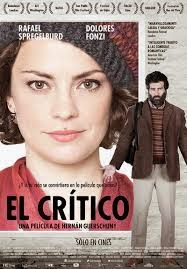
Title: The Critic (El Crítico)
Year: 2013
Genre: Comedy, Drama
Director: Hernán Guerschuny
Writer: Hernán Guerschuny
Runtime: 98min
Cast: Rafael Spregelburd, Dolores Fonzi, Ignacio Rogers, Telma Crisanti, Blanca Lewin
Produc.: Haciendo, Lagarto Cine, Storyboard Media

Argentinean movies never cease to amaze me. It´s not to tear down the local stuff, because we have good things, but I must admit that our neighbors, with whom we´re so much compared to, and to whom is said we look alike, in this they are ahead of us and The Critic is another example.
Debutant writer-director Hernán Guerschuny (of whom I hope to see more) starts up by talking precisely about cinema, and in a way that would appeal to both, the mass audience and the more selected.
Victor Telles (Rafael Spregelburd) is in this movie, a critic of those, very close minded, whose appreciations of the cinematographic language believe to be unique and indisputable, and who are unable to respect others opinions. Telles belongs to those who know by heart the audiovisual codes, with so much seen, tool with which he destroys everything he sees. Telles says to be an intermediary between public and movies, to avoid viewers having to see a lot of junk. Which doesn´t imply that the viewer should like this filter, or that Telles´s opinion, much more than sacred, isn´t just one more.
The Critic is partly about our way of seeing movies and it´s director shows several viewpoints. I would say that he prefers to take elements from each of them.
A voice-over in French serves us as the introducer. It is supposed to be Telles speaking, choosing not to use his own language, although it´s not him who we hear. Each time the voice reappears will always be in this language. To this, Telles, a follower of the New Wave current, externalizes this fanaticism, using it with his ex partner, an action taken from Breathless (1960), but completely mistaking the place, person and circumstances. Same as the voice-over, it represents another allusion to the times of Goddard, director idolized by many and hated by others.
In another scene, with Telles and his niece Agatha (Telma Crisanti) sitting at a table, the girl makes him see what she says to be an experimental short film. Telles fixes his lenses in his attitude of bug-headed critic, to better capture the registry of a setting where nothing is happening. Then, they both see as someone enters the frame, and Agatha smiles because his uncle has fallen in the joke, realizing that, that´s the building´s security camera. The director has intelligently teased the "real cinema" lovers, what any critic with a brain should humbly acknowledge.
It is there actually, a real cinema and one that isn´t? What is it or should cinema be, to begin with? Art or entertainment?  A way of transmitting a message? Or perhaps, all of this together? That´s of what we´re spoken about, although without being a fundamentalist stance towards an option.
Telles discussing with Agatha on the miss use of kisses in the romantic genre, or saying how is that cinema´s being long dead, are moments of reflection. On a cinema that´s precisely far from dead, when Guerschuny himself makes use of a language, theoretically overused, but that works for him.
After our unfriendly and demanding critic falls for Sofia (Dolores Fonzi), part of his perception begins to change, feeling that his emotions are being touched by a girl who enjoys movies without so much analyzing. Telles lives in the flesh that stage of meetings and understandings, typical of that genre that he himself rejects, and which Guerschuny does parody to. Telles is suddenly capable of empathizing with characters in bad movies, or to express himself in a hyper cheesy way, with that girl he doesn´t want to see leave.
In his role as a "movie terrorist", as he´s called by his boss (an expression I loved), he´s a victim of the laughter and hatred of people, who don´t understand how this guy doesn´t like any movies.
Even Leonardo Sbaraglia´s little appearance is a resource that contributes to the narrative, while paying tribute to the art of filming itself.
The Critic has then, a bit for everyone. Romance, comedy, parody and up to some madness, as the director reflects and entertains alike.

My rating: 7/10


Para acceder a la versión en español haga click aquí

10/06/2014

"What happens in bed, stays in bed"

Title: Sex Tape
Year: 2014
Genre: Comedy
Director: Jake Kasdan
Writer: Kate Angelo, Jason Segel y Nicholas Stoller (screenplay)
Runtime: 94min
Cast: Cameron Diaz, Jason Segel, Rob Corddry, Ellie Kemper, Rob Lowe, Harrison Holzer,
Produc.: Escape Artists, LStar Capital, Media Rights Capital, Sony Pictures Entertainment
Budget: $40 million approx.

Views on the importance of sex are varied, and there are both, those who need to do it often, as those who don´t see it so necessary. However, it would be to deceive us, telling us that good sex doesn´t help a good relationship, because the understanding in a couple isn´t only based on good dialogue.
As we see in Sex Tape, young Annie (Cameron Diaz) and Jay (Jason Segel) have no problems in this area, being perfectly able of adjusting themselves to different scenarios for their romps, this being an activity they practice often. It´s just that sometimes, monogamous practice can lead to carelessness, and although it´s never clear whether there are reproductive interests, the consequences are visible. Clive (Sebastian Hedges Thomas) and Nell (Giselle Eisenberg) are two children that, wanted or not, end up arriving, requiring attention and making it impossible for their parents to intimate.
Something I don´t doubt also to be true (even not being a father myself) is that there must be nothing more gratifying than having children and devote yourself to them. These are special beings that change your priorities and ways of thinking, and for whom we tend to enjoy the change. What doesn´t mean that there are moments that every parent has the right to take, and the possibility of keep having sex is one of them.
Here it is never clear if is it that this couple is disorganized or what, but with their kids playing around they end up putting aside the enjoyment of their own bodies. A practice that then, they don´t know how to retake. Annie and Jay mastered the art of doing it, just as a player would dominate a ball. But now parenting has taken away their training, becoming their attempts a failure to be the ones they used to. With such unusual problems as for Jay to have an erection, when back then his cock looked like an always ready boy scout, capable of smelling Annie from the distance. Still, Annie has already talked to her mother and that night the house is all for them, so solutions ought to be found right away.
Many might disagree with this of filming ourselves, but I think, crazy or not, in intimacy everyone does what they please, and fantasize whatever way they find in fun. In this case we are obviously in front of a comedy, so this madness must especially be seen with humor. Although, we ought to understand that Annie doesn´t come out with this idea so much for wanting to do something picaresque, as for wanting to spice things up and regain to have that sexual spark that seems lost. I would say then that the idea isn´t bad, but understandable. As I said before, in intimacy, each in his own way.
Luckily for the couple, the occurrence results in three long hours of that, they had been putting off for so long. Unfortunately, their hot video is then stored in Jay´s computer, who accidentally sends it to multiple contacts, through their iPads. Jay will explain Annie how such a thing could have happened, but understand it isn´t relevant. It´s enough to know that others could see it.
Recently, I just started to watch the already ended sitcom How I Met Your Mother (2005-2014) in which Jason Segel also used to work, and I put it up just to emphasize that, with a good script, this actor does comedy well. However, in Sex Tape Segel lacks the magic that characterized him and the rest of that serie´s cast. Especially cause in it Segel had counted on good material, which does not happen here, this having being a false step that, let´s hope, he´s already gotten out of.
Once Annie and Jay are aware of their mess, a comedy that is funny little becomes quite ridiculous. Annie and her husband begin a desperate journey in search of those copies, but with no idea of what they will do to get them. I think that neither Segel himself (here co-writer) nor his fellow librettists knew how to be original, deciding it would be good to see him been beaten, and her, snorting cocaine. Besides, it couldn´t be missed the strangeness of seeing Rob Lowe as an eccentric businessman, in whose house there´re distributed paintings with images of The Lion King (1994), where in each, his face replaces the character shown. What could this mean? One may ask. I guess cocaine really circulated.
The only thing that ends up being minimally funny, or I´d say that, rather curious, is when we ourselves get to see part of that video, right in the end, and that's the most fun. It must have been great for the actors to shoot several segments of a fake erotic video.

My rating: 1/10


Para acceder a la versión en español haga click aquí

8/21/2014

"They suffered death. Us, their romantic scenes"

Title: The fault in our stars 
Year: 2014 
Genre: Drama, Romance  
Director: Josh Boone  
Writer: Scott Neustadter and Michael H. Weber (screenplay); John Green (book) 
Runtime: 126min 
Cast: Shailene Woodley, Ansel Elgort, Nat Wolff, Laura Dern, Sam Trammell, Willem Dafoe 
Produc.: Temple Hill Entertainment 
Budget: $12 million approx. 

At only 13, lung cancer is detected to Hazel (Shailene Woodley), and on the verge of death, an experimental treatment is what saves her. Years later, her parents make her attend a support group which doesn´t excites her, until she meets there a boy named Augustus (Ansel Elgort). "Gus," to whom an osteosarcoma had snatched him off a leg, doesn´t attend it for his own wellness, but to accompany a friend. 
Based on John Green´s novel, The fault in our stars is a little bit long, teen romantic drama, where two kids touched by variants of the same disease find each other and fall in love, with all what that entails, given the circumstances. 
To suffer, at 16, from anything other than a cold or the chicken pox, I think would be an injustice, when being so much road ahead. There would be nothing to reproach Hazel if her most usual face was of bitterness, if she depended on drugs and on a ventilator, and had to have regular check-ups, plus never knowing when would be she taking her last breath. For all this is that, when hitting Gus she would be giving the timeliest and welcoming accidental step. 
Two years older than Hazel, Gus is an optimistic and of great self-esteem boy, of whose story with cancer is not spoken much until further on, except for us to learn that he´s using a prosthetic leg. What matters is that Gus has no problems asking her out, disregarding that she breathes through tubes and starting a relationship with the girl he likes. 
The fault in our stars addresses, on one side, one of the most beautiful sensations known to man, as it is being in love, while touches one of the worst fears. The fear of losing that person for whom you feel so much affection. The big problem into which, however it falls, is that the romantic part, beyond the cliché, is excessively long. While the gripping and tear drama these two lovebirds in disgrace are condemned to live, appears quiet late. 
Watching it reminded me of Love and other drugs (2010), that although, with another kind of developing and already adult characters, did also had a boy (Jake Gyllenhaal) willing to make his life next to a girl, sick, (Anne Hathaway) in this case, with Parkinson's, and when he himself knew what it meant, besides that, from outside, he was encouraged to leave her. In itself, making comparisons, given the differences between one another wouldn´t sound very fair. But what they do have in common is a love story that if you saw in the first one, it may be a bit repetitive to see in this other. Hazel herself is, in this teen drama, the one in charge of telling Gus that, given her condition, nothing can ever happen between them, that surpasses friendship. Something we already know will happen anyway. 
The fault in our stars has got an interesting dramatic content, with questions like How to live, knowing that what you´ve got is terminal? How to live the falling in love, when, perhaps, the time they´ve got is too thin? How is it your daughter´s condition lived as a parent, when you know that she´ll be living the world long before you? Or who said that the terminally ill are not entitled to find someone? 
The bad thing is that all this is mostly reserved to us for last. While before we are bored with each step of a love story which, throughout the first act and then some more, lacks of elements that could put it above others (although undoubtedly, may be liked by the female audience, just the same). So much so that, arrived the dramatic chapter (which had already begun, but very segmented) one could say ¡Hallelujah! But not for wanting the worse, with a morbid desire to see the characters suffer, but because outside the obvious fact that these guys had met for sad reasons, the process of "seeing each other", "get to knowing each other" and "falling in love" it´s just as cheesy and beautiful and gooey as has always been seen, and made me say to myself: when´s the real conflict coming? 
It would, however, be unfair of me not to highlight the very good performances in both lead roles, which make one to really feel that when they cry they do so because they suffer from their both, strong and harsh reality. 
By the way, if this adaptation was perhaps true to the novel, then I dare to say, of what was written by John Green, that it must have too many needles pages at the beginning. 

My rating: 6/10


Para acceder a la versión en español haga click aquí

8/13/2014

"Mistakes happen. But family is the one that loves you and raises you"

Title: Le fils de L'autre (The other son)
Year: 2012
Genre: Drama
Director: Lorraine Lévy
Writer: Noam Fitoussi (original idea), Lorraine Lévy and Nathalie Saugeon (screenplay)
Runtime: 105min
Cast: Emmanuelle Devos, Pascal Elbé, Jules Sitruk, Mehdi Dehbi, Areen Omari, Khalifa Natour, Mahmud Shalaby, Ezra Dagan
Produc.: Rapsodie Production, Cité Films, France 3 Cinéma, Madeleine Fims, Solo Films, Orange Cinñema Séries, France Télévision, Useful Production, Hoche Artois Images
Budget: $2.700.000 million dollars approx.

About to turn 18, Joseph Silberg (Jules Sitruk) takes a routine medical checkup, seeking admission by the IDF. The results are received by Orith (Emmanuelle Devos), his mother, who realizes that there´s something that´s not right. Her son´s blood type doesn´t seem to match with hers or her ​​husband´s, so she decides to find out what´s happened, in fact, afraid to know.
The moment of the truth arrives when the Silberg´s, along with another couple, the Al Bezaaz, are received by the current director of the hospital, where Orith and Leila (Areen Omari) had given birth, and so that unfortunately they are confirmed of the worst. In that distant day, newborns Joseph and Yacine (Mehdi Dehbi) had been whisked to a shelter during a bombing, so that later, with all the commotion, were to be given to the wrong mothers.
Having the doubt been removed (and with the boy´s pictures having been exchanged in the middle), they are diplomatically offered an apology, but as thing´s gone, the damage is already done.
If we were to define life circumstances that are within the completely unexpected and difficult to bear, I think that what was experienced by the Silbergs and the Al Bezaaz qualifies. If it´s hard enough already to learn how to be a parent, or having to decide, for example, to adopt, to find out after 18 years that your biological child has been raised by others and that you´ve been raising theirs, must be a dreadful finding.
The other son tells about how difficult it could be to get to assimilate this situation, both from the point of view of the parents, of their children or their siblings. If as a father you´ve lived moments of father and son, you did it with the person with whom in principle and biologically speaking, you were not supposed to. If you had him in your belly, it´s quite sad to know that who called you "mommy" for the first time was not the same child. But living all that aside, if as a child you grew up in a certain culture, language and ways of thinking, perhaps it´d be even harder to absorb if your real parents were of a different one, and probably tougher would be to internalize it as a teenager. Unless one had quickly matured and had another kind of understanding.
In any event, the above would actually be attached to a package of emotions that would be within the logical and expected. This movie, however, goes beyond this pose given the geographical space where it happens.
Hand in hand to what is told to us has also been to show us some of the socio-political and cultural situation, of these Israelis and Palestinians faced today. Watching myself the film and with all the respect that these cultures deserve, I just couldn´t help it but to feel grateful for being born in the Río de la Plata.
Many things might be said of the Uruguayans. That we´re racist, that we are this or that… but I think that in no way we are as culturally close as these people in anyway, which is a privilege. And it goes without saying that, the more open is a culture the more likely one is less attached to certain guidelines from the ones that rule coexistence.
In The other son, already the starting point is a human error occurred during a "human horror", that is, war. A conflict which, with its ups and downs, has been going on for decades and of which here is spoken from a little discussion between fathers, to when we are shown the border crossing and a section of the West Bank Barrier.
The other thing that is put into evidence is how terrible would be something like this in the Middle East. What I mean is that, of occurring between a Uruguayan and an Argentinean family, other than the obvious shock there would not be such a big cultural change. Inversely, the religious frame surrounding Joseph and Yacine is very strict. To the extent that for some is difficult to focus on helping them feel good, above what they might choose to believe or not, according to their now, true roots.
For my liking, first should be the individual´s welfare as a person, and only then our own spiritual belief. Unless that his welfare itself was linked to his own spirituality.
Here, speaking with a ravine, given his identity crisis, Joseph Silberg goes in search of guidance. Although, more than anything, wanting to be told that everything is fine and that he can stay the same, for his already taken path, for his attachment to Judaism and for his attitudes towards the cause. However, more aware of his millenary rules, this old man chooses to explain him how is it that you are or aren´t Jewish, scaring him even more, rather than empathize and tell him something like "Don´t you worry. Today is not about God, but about you". I´d like to suppose that, for the non-fundamentalist believer, a person is more valuable than his beliefs, where this doesn´t seem to be the case.
The other son then, speaks of all this. We are briefly described the political and geographical derivations of this war, while it deepens into the critical and irreversible situation, sadly, a direct result of the confrontation. Situation which, if ever happened to us, could have us wondering why, for a lot of time. Then if we were Israelis or Palestinians, we´d be thanked that our children, at least, despite the mistake were able to survive the day they were born.
Parents, on the other hand, I think it´s worth saying that will always be those who raised you and loved you, and whom you called mum and dad from the beginning. What later might happen in the future is analyzed at the moment. But the one which supported you will still be your family.

My rating: 7/10


Para acceder a la versión en español haga click aquí

8/05/2014

"Homaje... or imitation? part 2"

Title: The house of the devil
Year: 2009
Genre: Horror, Mystery
Director: Ti West
Writer: Ti West
Runtime: 95min
Cast: Jocelin Donahue, Tom Noonan, Mary Woronov, Greta Gerwig, AJ Bowen, Dee Walace
Produc.: MPI Media Group, Constructovision, RingTheJing Entertainment, Glass Eye Pix

Two years ago I saw Alien Trespass (2009), a science fiction title where an extraterrestrial being took control of a human body, with the intention of conquering the Earth. Then, a few days ago I saw The house of the devil (2009), a horror film where a young college student was deceived and used for a ritual. Although completely different from each other, both shared to have paid tribute to a much former cinema.
To honor in this business has always been very common, as with the Cecil B. Demille award given to celebrities for their lifetime achievement.  But luckily this doesn’t only happen in such circumstances, being the nods that some directors make to their fellowmen, putting some else’s words in the mouth of their own characters, replicating their aesthetics and even their camera approaches. Any of these options would work, unless, like Ti West, they choose to completely trace a style, rather than just taking certain things.
If at its time it had already happened to R. W. Goodwin’s Alien Trespass, that this were now to happen to The house of the devil would only confirm it: these men had misunderstood what was to pay homage.
I can’t know it for sure, because both could have been made only on request. I want, however, to believe that both Goodwin and West felt, in fact, a strong attachment to their projects. Inspired to going back to that movies, today distant and boring, but great before, and from which they would both nourish.
Yet, if was West had sought to demonstrate was that the past is not forgotten, certainly to accurately copy what he’d seen in his childhood was not exactly recommended. I can already imagine how many who hate remakes wont probably even notice that The house of the devil is nearly one, blinded by their admiration to a cinema they praise, while they criticize the current one without much criteria. It’s very common to idolize the past, while the present is destroyed.
From the credits design to the close-ups on the characters, Ti West wouldn’t leave anything to chance, trying to recreate the style of the seventies-eighties terror, and even rolling in 16 millimeters for the texture. Having us seen it without any knowledge of its director or its cast we might have thought that this movie was from that era.
In The house of devil, young Samantha (Jocelin Donahue) comes across a babysitter request that will run her into the mysterious, liar and dangerous Mr. Ulman (Tom Noonan). This will receive her at his home, where he plays the needy and varies in his lies, while convinces her of that, whatever it may cost, that night her presence is required.
Sticking, without variants, to the honoree style, West would forget to include a personal and different touch. Between Samantha speaks to Ulman on the phone, goes to do her job and discovers the real reason of her stay, nothing happens that one wouldn’t be able to see in any film from the ones made ​​at that time. The house of the devil would end up been an unnecessary clone, only justifiable if it were to be an exercise of setting, done by students at a film school.
A girl taking care of someone who never sees, a house which hides a terrible secret and a couple with diabolical plans are part of a plot that, given its characteristic suspense only barely sustains itself and for a while, meanwhile one awaits to happen that original something that never comes.
If hypothetically speaking, we replaced West and the 2009 with a name and date more in line with the alluded cinema, that The house of the devil could have pass for a distant production, I think it means that today it has no place.

My rating: 4/10


Para acceder a la versión en español haga click aquí

7/16/2014

"An ending that deserved a better movie"

Title: The lego movie
Year: 2014
Genre: Animation, Adventure, Comedy
Director: Phil Lord, Christopher Miller
Writer: Phil Lord and Christopher Miller (screenplay); Dan Hageman, Kevin Hageman, Phil Lord, Christopher Miller (story)
Runtime: 100min
Cast: Chris Pratt, Elyzabeth Banks, Will Arnett, Morgan Freeman, Channing Tatum, Jonah Hill
Produc.: Warner Bros., Village Roadshow Pictures, Dune Entertainment-RatPac, The LEGO Group, Vertigo Entertainment, Lin Pictures
Budget: $60 million approx.

For those of us who know what Lego is, we may like the movie more or less, but I doubt that visually speaking there´s anything to complain. From the shots in a shootout to the water flooding a submarine, all of what´s digitally created matches the design of the little bricks. And even the way the mini figures move their legs, arms, hands and heads is correct.
If, however, objections where to be for the how it was all built, then indeed, there could be a reason for discontent. Although, being this a matter that lends itself for the analysis.
In The Lego movie, Emmet (Chris Pratt) is a common guy, a construction worker, of whom one day the fate of the world becomes to depend on, against the villainous Lord Business (Will Ferrell). Succeed will require Emmet of the help of Wyldstyle/Lucy (Elyzabeth Bakns) and of Vitruvius (Morgan Freeman) advises, beside a battalion of characters, fictional and real, willing to follow him.
It was to be expected, for this adaptation, to want some of the Lego collections to be mention. That it is why, out of nowhere appears the Wild West or the Middle Ages; that without a reason Wyldstyle/Lucy is dating Batman (Will Arnett); or that Gandalf (Todd Hansen) from The Lord of the Rings has also got a line.
But the idea should be far from fulfilling the expectations of the older audiences, for being too childish and have an excess of characters. Not even the constant jokes, with references to comics or other expressions are able to improve a movie that is impossible to take seriously.
Nearing then, to the happy and predictable battle finale, and when it seemed to be all said, everything that´s been going on ends up being part of an unexpected twist. Suddenly, that random great mix of characters from different realities, eras and genres has just happened to have a well-defined why. Only just now we see a conflict that we do care about, with opposite interests that truly meet, and of whose resolution we, more than ever, want to be aware of.
The only thing essential until here has been for us to be patient or capable of seeing this film for what Lego ultimately was: a kid´s game.

My rating: 6/10


Para acceder a la versión en español haga click aquí